

No overview
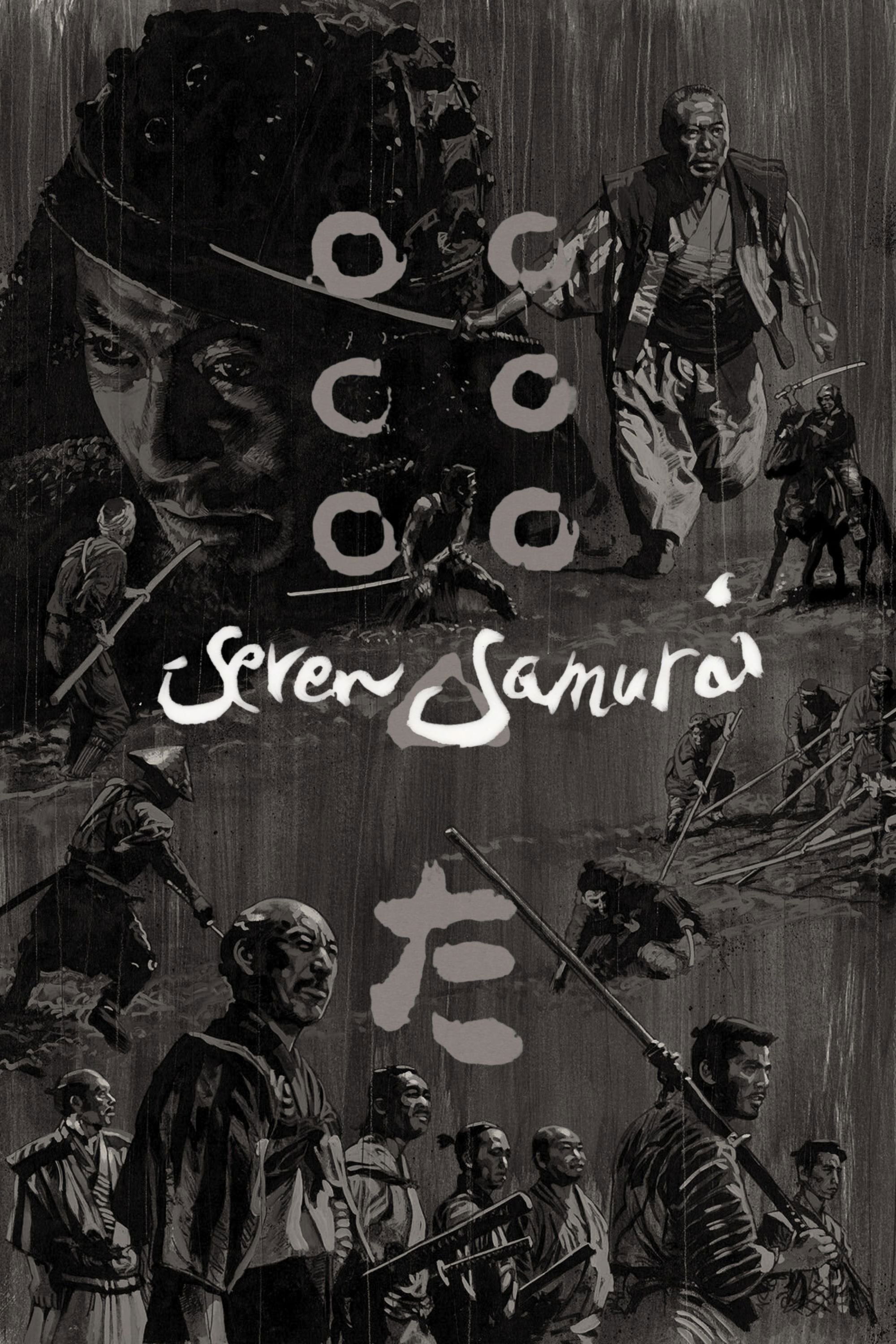
Seven Samurai
七人の侍
- Status: Released
- 26-04-1954
- Runtime: 207 min
- Score: 8.45
- Vote count: 4091
A samurai answers a village's request for protection after he falls on hard times. The town needs protection from bandits, so the samurai gathers six others to help him teach the people how to defend themselves, and the villagers provide the soldiers with food.
Cast
Trailer
Review
Fantastic movie with a great touch of reality.
At the top of my favorite films ever. Every time I watch it is see something new. Bandits steal peasants rice. Peasants hire ronin samurai to defend them. Great plot, pace and acting. Akira Kurasawa's best...perhaps.
**Maybe a little overrated, but there's no doubt that it's good.** Well, I have to start this text with a note that I believe is relevant to understand what I'm going to write: this was the first Japanese film that I remember seeing. I might even be forgetting something I've seen before, but I don't think so. Therefore, I'm not a good connoisseur of Japanese cinema, so I don't want my opinion to be taken with any authority that I don't crave. I know there are people who want that. I do not. I speak, as in any of my reviews, only through my mouth, from the height of my meager wisdom, without pretensions. I may be right about some things, wrong about others, but that's the most normal thing in the world. I decided to see this film because it was highly recommended and well regarded… everyone said it was a very good film, so I decided to see it for myself. I just finished it, and read a little about the film and its director, the famous Akira Kurosawa. The film is really a work that is above average, but it is not the kind of film that pleases everyone, and it seems to me to be a little overvalued, which results in damage. I say this because I felt, at various times, that the film failed to meet my expectations, as I am quite neutral, that is, I neither love this type of film nor feel repugnance in watching it. The script takes place, roughly, in the mid-16th century, when Japan was divided into feuds and kingdoms, and there were frequent internecine wars in which the samurai took part. Of course, in such an environment, it is the common people who sacrifice themselves, and the humblest have always been the most susceptible to abuse by the powerful. That's what we have here, with a rural village that is regularly looted and devastated by an armed band until it decides to hire a small group of wandering samurai to help defend it. They achieve this objective, and we are invited to see all the labors that occur in the preparation of the defense, and in the martial training of those peasants. I'm going to do it differently, and start by saying the aspects that seemed most positive to me. First, it seems to me that Kurosawa is really meticulous in the work he has done and has great affection and respect for his country's traditions and history. Otherwise, one would not understand the effort and money that were tied up in a film with such a historical and cultural load. To what extent did his taste for realism influence European cinema, or vice versa? I'm sure there are film students who have discussed this. What I can guarantee is the commitment to realism, visible, for example, in the extraordinary design of the sets and costumes, and in the static cinematography, very elegant and sharp. The script is quite solid, and gives us an extraordinarily credible story and very well-built and striking characters. I don't know the actors well, but I think Toshiro Mifune deserves applause for the commitment and work he has done here. He is an actor who naturally captures our attention and has a charisma that comes through effortlessly. On the negative side, however, we also have several aspects to point out, starting with the length of the film, with more than three and a half hours. I'm sorry to say, but I feel that the script didn't justify that much time, and that Kurosawa didn't work the pace well. With a more restricted edition, he would have managed to reduce the film, without much loss, to two hours, and make it less heavy and exhausting. We don't need to see every village debate or every military training shenanigans. I also didn't like the attempts at humor introduced in the film. They just weren't funny at all. The excessive predictability of the story told also turns out to be a defect. I also didn't like the virtual absence of a soundtrack. I've seen that in other films, and I've never been particularly fond of that stylistic device.
I must begin by saying I am a bit "attention deficit" and that I never thought I would like subtitles, but this film flows through its long length with such adventure that I don't see how anyone can keep from being entranced with every second. And it takes a lot to hold my interest. In case you haven't heard, this "magnificent seven samurai" so to speak, are enlisted one by one to aid a village beset by 40 bandits. What is often lost is that the story is really "Four villagers". Two are village elders (although not as old as the "grandpa" character they look to for advice). One, Manzo, represents the conservative element that in our era might be called "Republican", and the other, Mosuke, represents the liberal or "Democrat" policy. The other two are Yohei, a man full of fear who thinks Manzo's policies will protect him; and Rikiki, the boldest villager who is more in tune with Mosuke. Indeed, Rikiki might qualify as the "eighth samurai" as the film progresses. There are so many wonderful subplots and so muuch excitement even when there is no action, that there's never a dull moment. The samurai also have their ups and downs. Toshiro Mifune is not the leader, but he is the soul. He is much like Rikiki. There is humor throughout that is perfectly timed, and much tragedy. I think it is Kurosawa's masterpiece, and he is one of the most respected directors of all time.
Maybe the greatest movie of all-time. This film is an epic accomplishment of long-form storytelling, amazing performances, wonderful camera work and fantastic sets. As is typical of Kurosawa, this movie attacks the theme of greed and is very willing to critically examine the high-status classes, in this case the "honourable" samurai. The characters are likeable for the most and the performance from Toshiro Mifune is absolutely masterful and his character is a brilliantly comic tragic character. The action is very raw with mud and rain and chaos, which I appreciate. The pacing in the middle is ever so slightly slow but it really doesn't detract from this utterly brilliant masterpiece.